HomeMaster Smart Home Modules — Controllers, I/O, Heating & Lighting
HomeMaster builds DIN-rail automation hardware for a wired smart home that keeps working on its own. A system is three parts: an ESP32 controller running ESPHome, an RS-485 Modbus RTU bus, and expansion modules carrying the field wiring — inputs, relays, dimmers, LED drivers, energy metering and leak detection. Everything mounts in a standard cabinet on 35 mm DIN rail and runs from a 24 V DC supply.
The controller connects to Home Assistant over the native ESPHome API: no MQTT broker, no Modbus register mapping inside Home Assistant, no cloud account. Entities appear within seconds of adding the device, and the logic you put on the controller keeps executing whether or not the Home Assistant server is reachable.
Kits
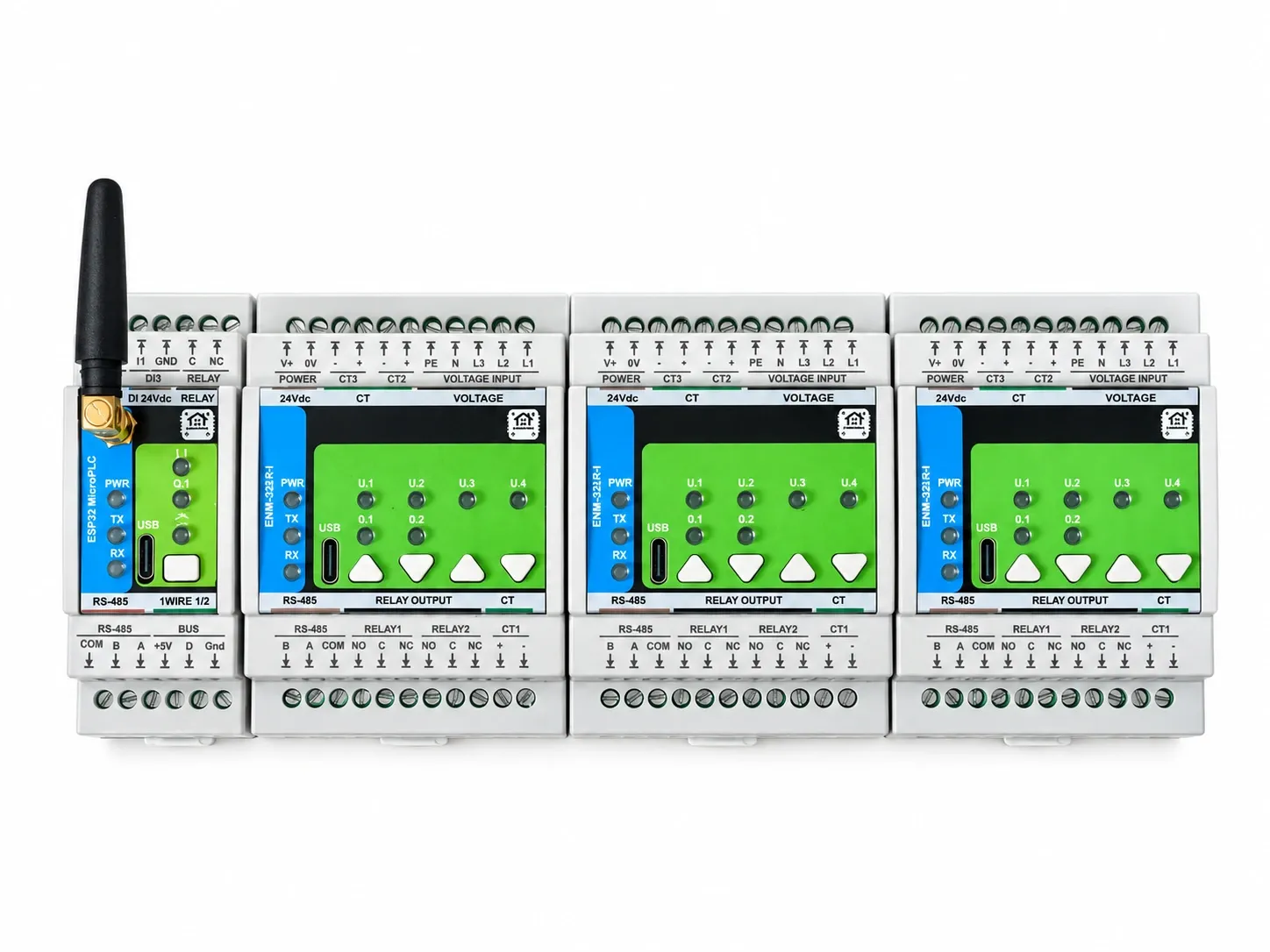
9-Channel Energy Metering Kit
MicroPLC, three ENM-223-R1 three-phase meters and nine 100 A split-core CTs. Nine circuit-level channels in four DIN modules, Modbus RTU, native in Home Assistant.
Controllers
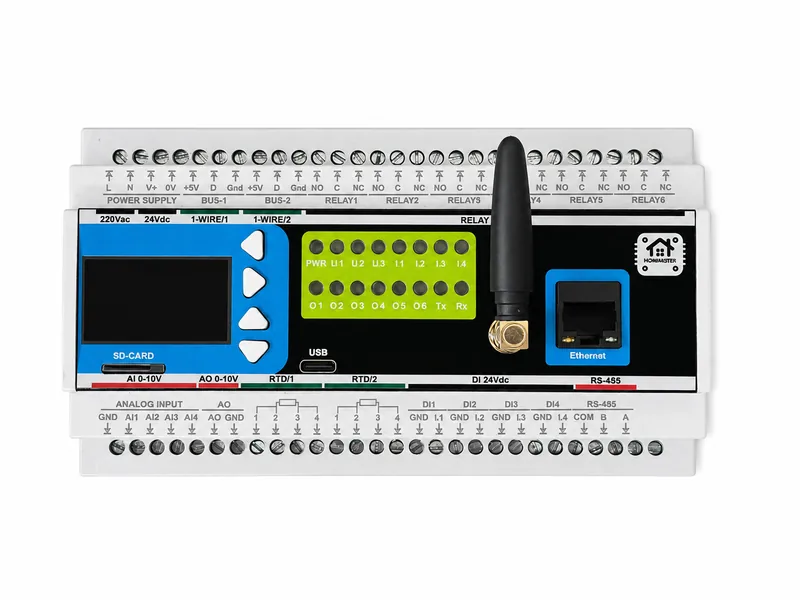
MiniPLC
Full-size ESP32 DIN-rail controller. 24 V DC or 85–265 V AC input, 4 isolated digital inputs, 6 SPDT relay outputs, Wi-Fi with optional Ethernet, battery-backed RTC and the RS-485 master port.
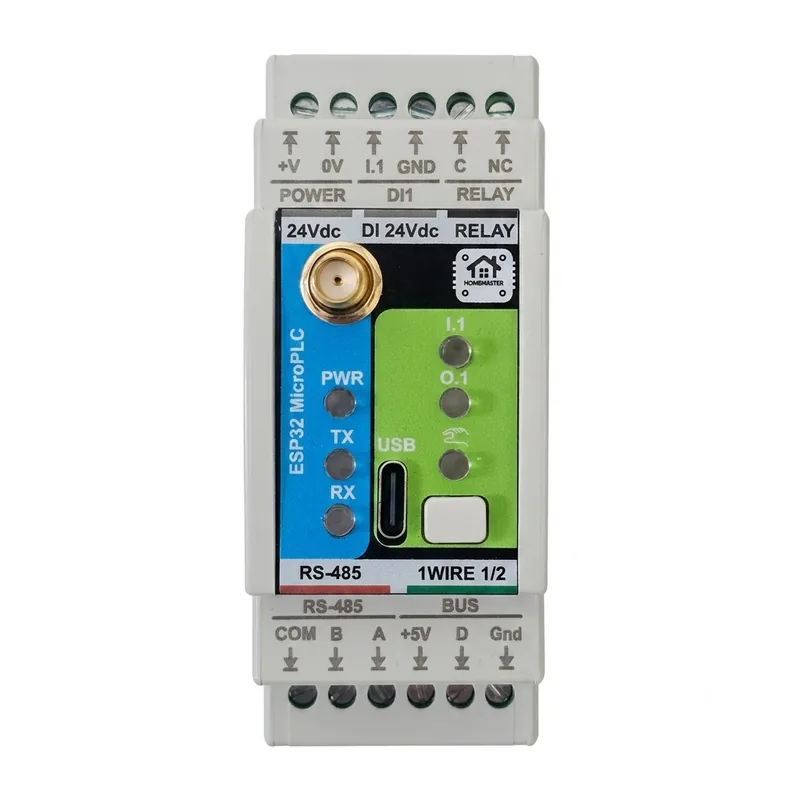
MicroPLC
Compact ESP32 DIN-rail controller. Same firmware and same processing as the MiniPLC, with digital inputs, one relay, battery-backed RTC and the RS-485 master port.
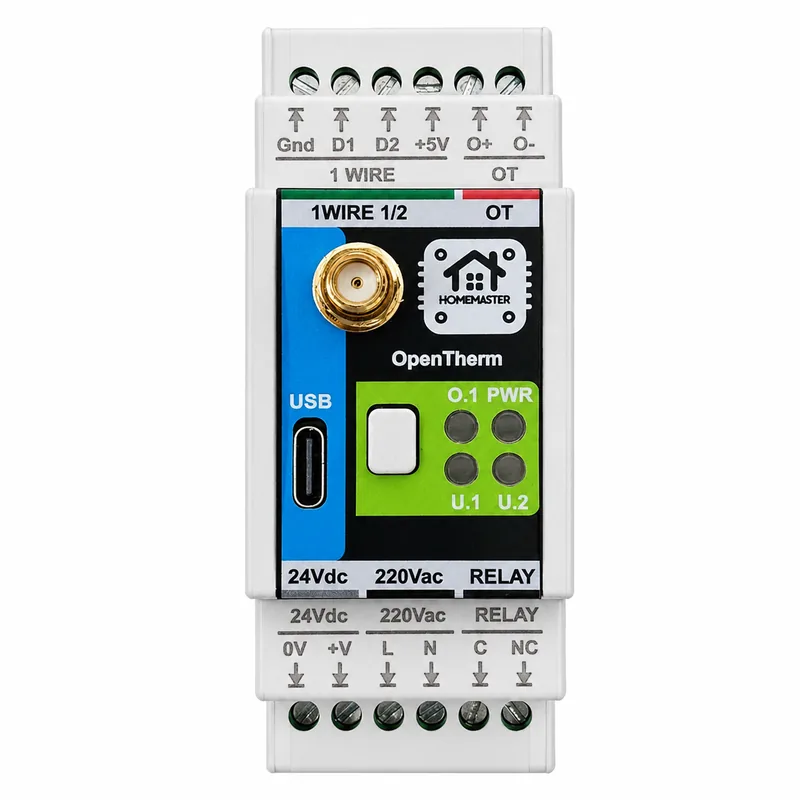
OpenTherm Gateway
Boiler controller speaking OpenTherm — modulation, setpoints, flame status and fault monitoring — with a relay output for zone valves or on/off boilers and two 1-Wire temperature inputs.
Expansion modules
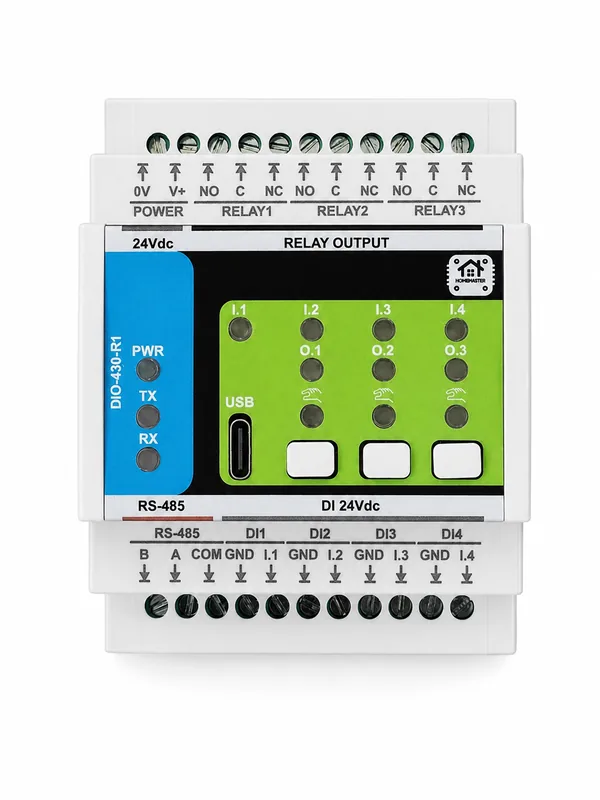
DIO-430-R1 Digital I/O
4 IEC 61131-2 compliant 24 V digital inputs and 3 relay outputs for lighting, HVAC and general switching.
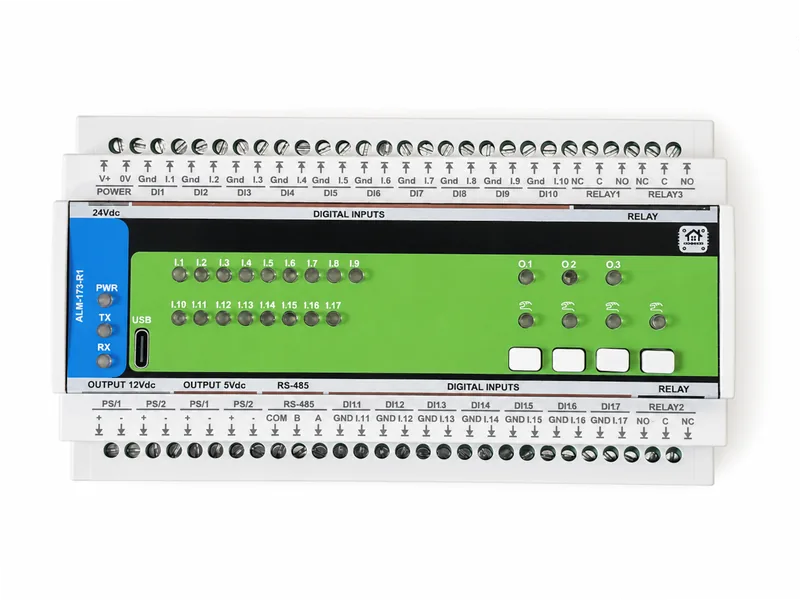
ALM-173-R1 Alarm I/O
17 opto-isolated inputs with per-input enable, invert and alarm group; 3 SPDT relays rated 3 A at 250 V AC; isolated 12 V and 5 V rails power PIRs and detectors directly.
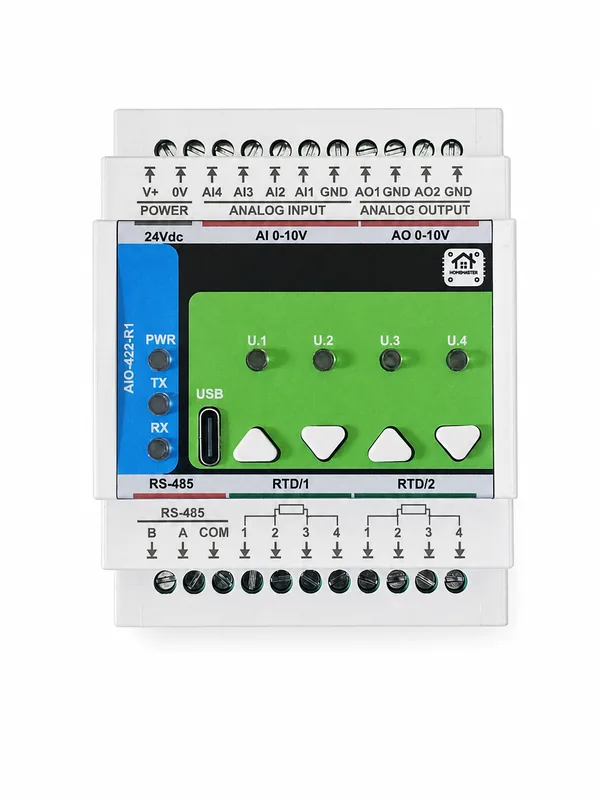
AIO-422-R1 Analog I/O & RTD
Four 0–10 V analog inputs (16-bit ADC), two 0–10 V outputs (12-bit DAC) and two RTD channels for PT100/PT1000 in 2-, 3- or 4-wire wiring.
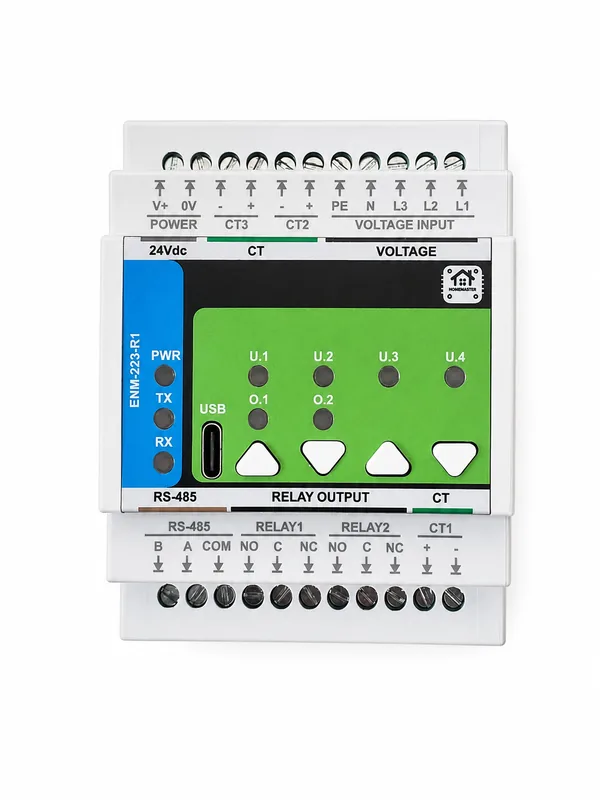
ENM-223-R1 Energy Metering
Three-phase energy and power-quality metering. L1/L2/L3-N voltage sensing, three external CT channels and two SPDT relays for alarms or load control.
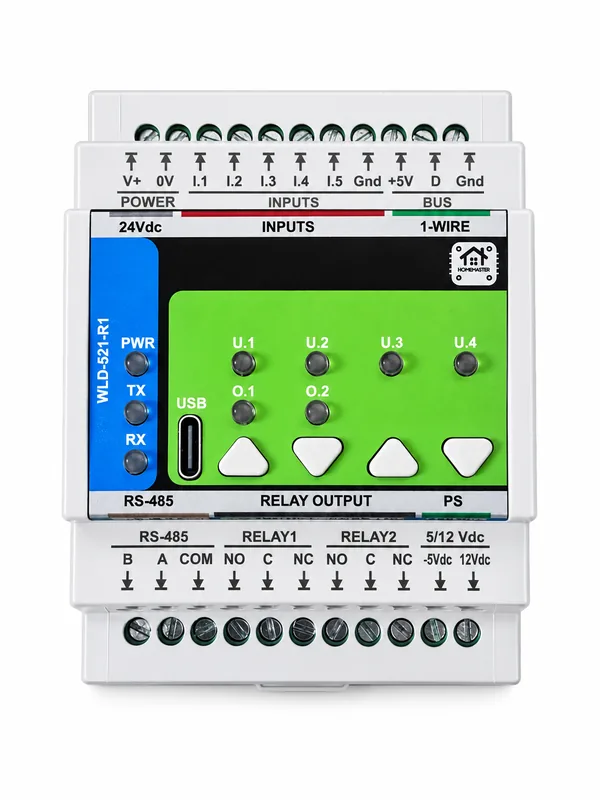
WLD-521-R1 Water Meter & Leak
Five opto-isolated inputs in sensor or pulse-counter mode, two SPDT relays for valves, isolated 5 V and 12 V sensor rails and a 1-Wire input for temperature probes.
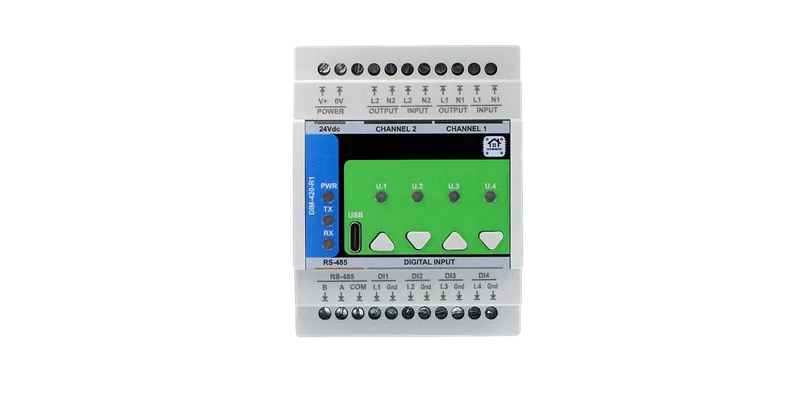
DIM-420-R1 AC Dimmer
Two-channel phase-cut AC dimmer, leading or trailing edge per channel, with four digital inputs supporting short / long / double / short-then-long press logic.
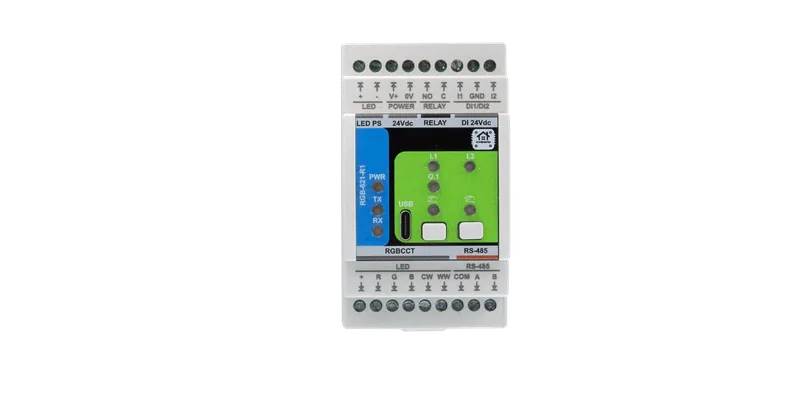
RGB-621-R1 RGB + CCT LED
RGB and tunable-white LED driver. Five PWM outputs (R, G, B, CW, WW), two digital inputs and one relay.
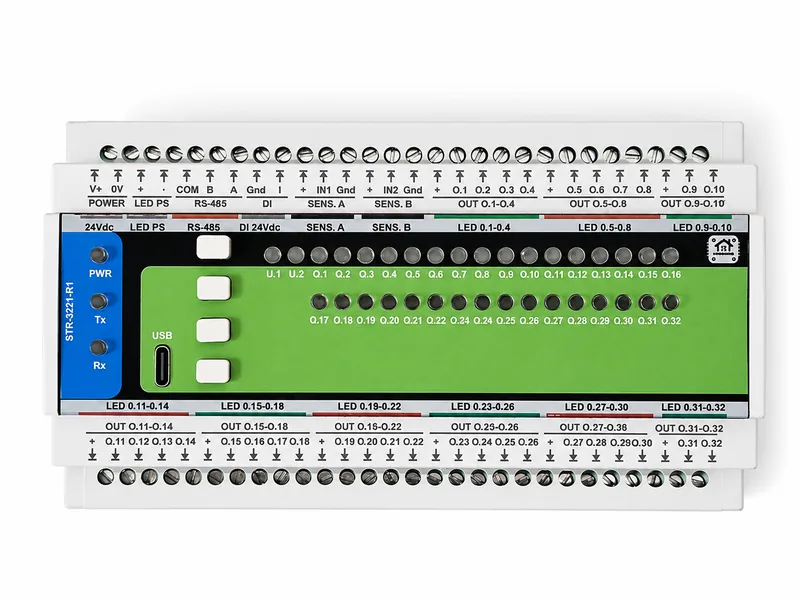
STR-3221-R1 Stair LED
Stairway lighting controller. 32 low-side MOSFET outputs for 12–24 V DC LED strips, one digital input plus two presence-sensor inputs, four buttons and four status LEDs.
How a HomeMaster system is put together
Start with one controller. The MiniPLC and the MicroPLC run the same ESP32 and the same ESPHome firmware — the difference is what is on the board, not how much they can compute. The MiniPLC is the larger unit: 24 V DC or 85–265 V AC input, 4 isolated digital inputs, 6 SPDT relay outputs, an optional Ethernet PHY alongside Wi-Fi, a battery-backed real-time clock and a front-panel interface. The MicroPLC is the compact version, for cabinets where the I/O lives in the expansion modules rather than in the controller.
From the controller, one twisted pair plus a common reference runs the RS-485 Modbus RTU bus around the cabinet. Each expansion module is a Modbus slave with its own address. Add channels by adding modules on the same pair — you are not re-pulling cable to the controller for every new circuit.
One wiring rule that is easy to get wrong: the RS-485 front end on HomeMaster controllers and modules is not galvanically isolated. It has transient protection — TVS diodes, resettable PTC fuses, a common-mode choke and fail-safe biasing — but that is surge protection, not isolation. Run COM to every node, and where the bus crosses into a separate electrical installation with its own earthing reference (a utility meter, another building, another cabinet's PE system), fit an external galvanic RS-485 isolator at that boundary.
Why a wired bus instead of wireless
Wireless devices are quick to install and cheap to start with. The cost shows up later: batteries to replace, mesh routes that change as furniture and neighbours change, vendor hubs that decide what your devices are allowed to do, and firmware that can be discontinued. A wired bus has none of those failure modes. The RS-485 pair is deterministic, it does not compete with your Wi-Fi, and it runs from the same 24 V DC supply as the modules.
Wiring also puts the hardware where an electrician can service it. All the I/O lands on pluggable screw terminals inside the cabinet instead of behind a wall plate or in a ceiling void. Modules are IP20 — designed for a control cabinet with a protective front plate over the terminals, not for outdoor or exposed mounting.
Local logic — what keeps running when something breaks
Every module stores its configuration in on-device flash and restores it at power-up. Input-to-output behaviour, button actions, LED sources, alarm groups and safety interlocks are configured on the module and executed by the module. A staircase keeps lighting, a leak valve keeps closing and an alarm group keeps latching whether or not the controller is polling and whether or not Home Assistant is running.
The controller does the coordination and the cross-device automations. Home Assistant, in this architecture, is the interface and the history — not the thing that has to stay online for the house to behave.
Choosing modules
Lighting and general switching start with the DIO-430-R1; dimmed mains circuits with the DIM-420-R1; LED strips and tunable white with the RGB-621-R1, and stairways with the 32-output STR-3221-R1. Security wiring — PIRs, reed contacts, tamper loops — goes to the ALM-173-R1, which powers the detectors from its own isolated rails. Heating and ventilation use the AIO-422-R1 for 0–10 V valves, pumps and RTD temperatures, with the OpenTherm Gateway on the boiler itself. Metering is split between the ENM-223-R1 for three-phase electricity and the WLD-521-R1 for water, leaks and irrigation.
Browse by category: Kits, PLC controllers, Extension Modules, Smart Heating Controllers.
Configuration and documentation
Modules are configured in the browser over USB-C using WebConfig, a Web Serial tool that runs in Chrome or Edge — no driver install, no vendor application. You set the Modbus address and baud rate, map inputs, outputs, buttons and LEDs, watch live channel values, and save to flash.
Firmware, WebConfig, datasheets, schematics, EU Declarations of Conformity and the ready-made ESPHome packages for every product are published at config.home-master.eu, with the hardware and firmware sources on GitHub. HomeMaster hardware and firmware are open source — the register maps, the board schematics and the configuration tool are all published, so nothing about the system depends on us continuing to host it.
Plan your system
If you know the rooms and circuits but not yet the part numbers, use the System Builder. Enter what the installation has to cover — lighting circuits, blinds, heating zones, sensors, metering — and it works out which controller and how many modules that comes to, how much DIN width it needs and what the bus and power budget look like.
A worked example: weather-compensated heating with the OpenTherm Gateway. Working through an installer or planning to resell? See the partner programme.
Compliance
HomeMaster products are CE marked. A signed EU Declaration of Conformity is published for each product and can be downloaded from that product's page. HomeMaster® is a registered EU trademark (EUTM No. 019082911) of ISYSTEMS AUTOMATION S.R.L., Romania.