How HomeMaster
Works
Smart Home Automation System with RS-485 and Local Logic
HomeMaster is a DIN-rail smart home automation system built on RS-485 Modbus. Every module executes its own logic on the device, the controller runs the logic that spans several modules, and the server adds visualisation and remote access — so the system keeps operating without internet or controller connectivity.
RS-485 Modbus architecture. Deterministic polling, module-level logic, DIN-rail format.
- Works without controller or internet
- Deterministic communication (Modbus RTU)
- Automation runs locally on every module
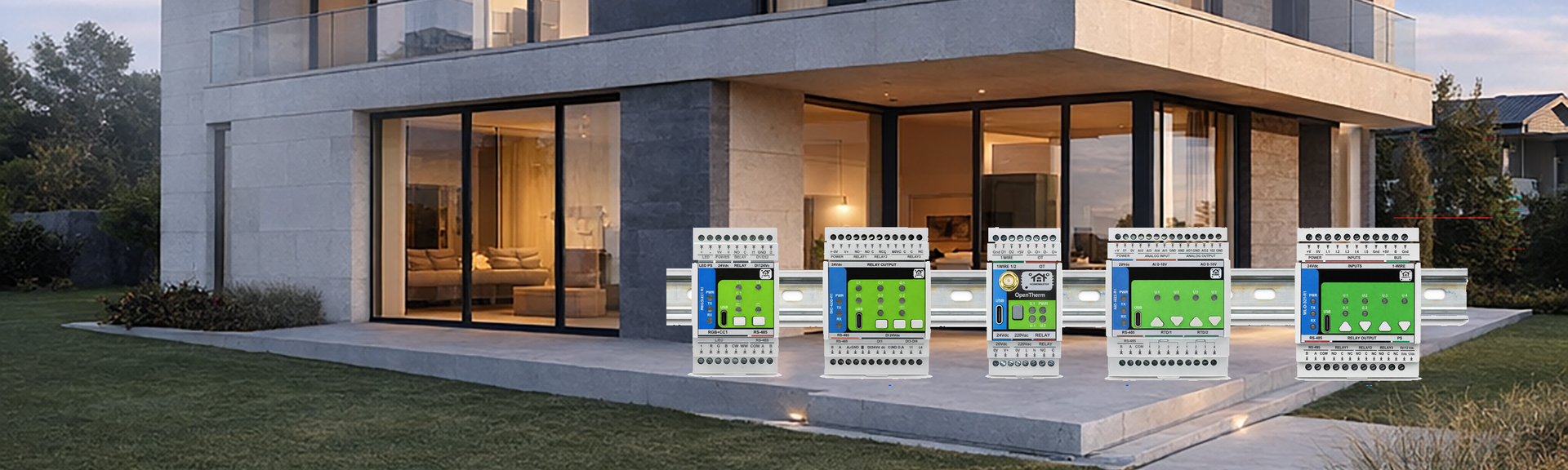
System Architecture (Controller, Modules, Devices)
Each module operates independently with local logic, ensuring system operation even during failures.
The system consists of four layers:
Where a rule lives is decided by how critical it is: a shutter interlock or a leak valve belongs on the module, a rule that reads one module and drives another belongs on the controller, and dashboards, notifications and scheduling belong on the server. How to wire a house so that choice stays open.
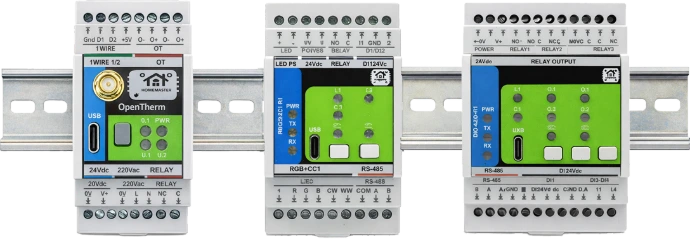
02 RS-485 MODULES
Expansion I/O
- Modbus RTU Slaves
- Relay, analog, PWM, RTD, I/O
- Local Logic & Autonomy
- DIN-rail mounted
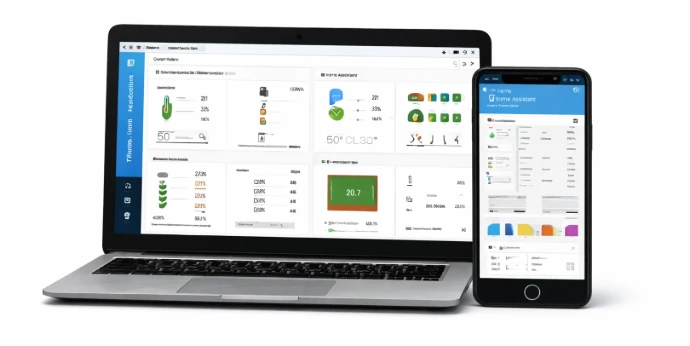
04 SERVER
Home Automation Server
- Dashboards
- Automation
- Remote Access
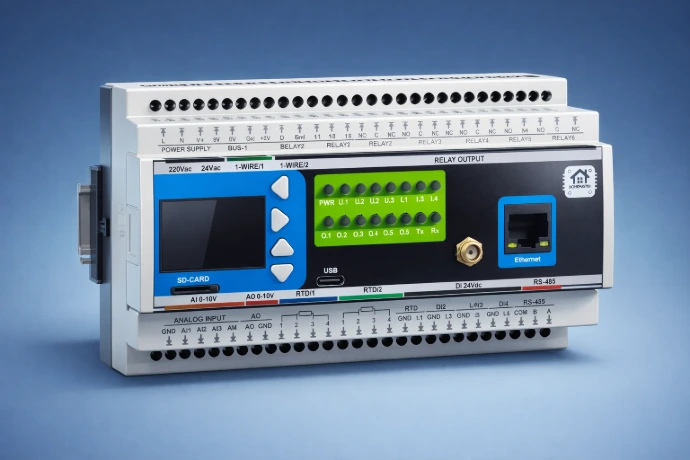
03 CONTROLLERS
MiniPLC/MicroPLC
- ESP32 + ESPHome
- Modbus RTU Master
- Central automation logic
01 FIELD DEVICES
Sensors & Actuators
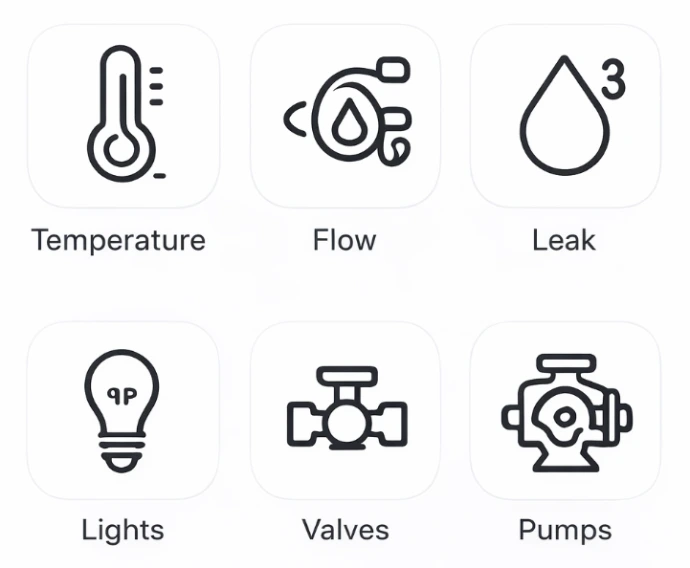
Automation Data Flow (Local, Controller, Remote)
Three ways the system can operate:
LOCAL OPERATION
Modules execute logic locally
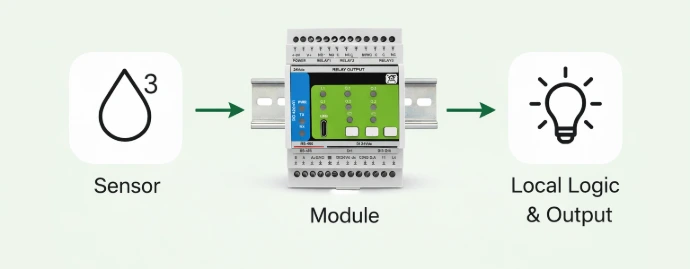
Example: Leak detected➡WLD module➡Valve OFF
WITH HOME ASSISTANT
Visualization, automation, remote access
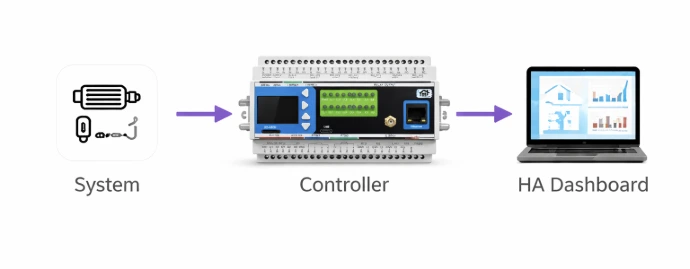
Example: Monitor, automate, control remotely
CONTROLLER-ASSISTED
Modules act as distributed I/O
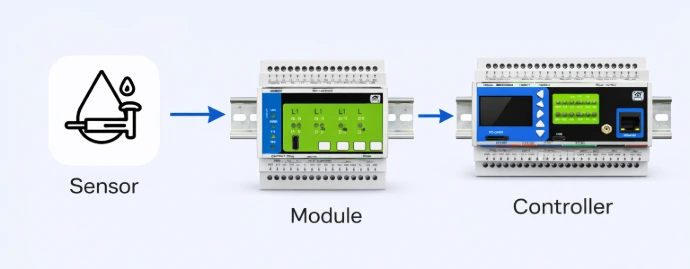
Example: ΔT detected → MiniPLC → Pumps ON
LOCAL LOGIC & AUTONOMY
Each module operates independently.
- Lighting continues working
- Pumps continue running
- Leak protection remains active
System does not stop — automation continues locally.
COMMUNICATION
RS-485 Modbus RTU
- Industrial communication standard
- Noise-resistant over long distances
- Deterministic real-time behavior
Implementation:
- Controller = Modbus master
- Modules = Modbus slaves
Bus topology, termination and the faults behind intermittent timeouts.
CONFIGURATION
Two configuration layers
1. Module-level (WebConfig)
- Modbus address
- I/O types
- Logic behavior
Configuration is done over USB-C in the browser and stored on the module itself, so it survives a power cycle and does not depend on the controller.
2. Controller-level (ESPHome YAML)
- System logic
- Automation rules
- Integration
BUILT FOR RELIABILITY
Engineered for real world installations.
✔ DIN-rail modules
✔ Open firmware and schematics
✔ Surge & isolation
✔ OTA updates on the ESPHome controllers
REAL SYSTEM EXAMPLE
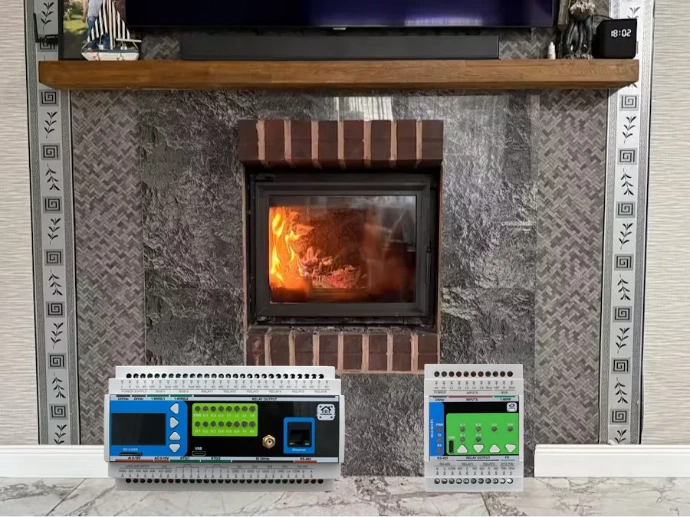
Chimney System
- Multi-sensor monitoring
- Energy calculation
- Pump & valve control
Works even during outages
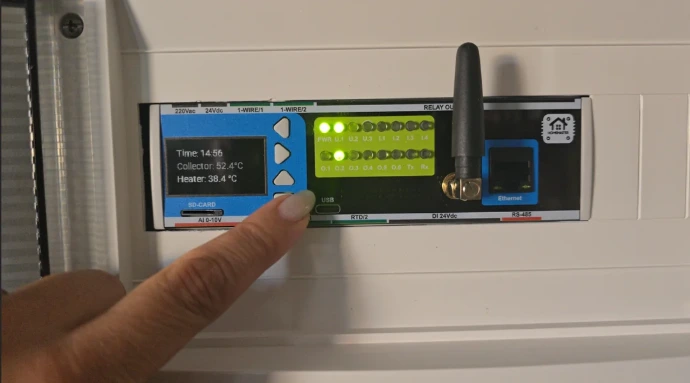
Smart Heating Systems
- ΔT-based pump control
- PT100 / DS18B20
- Flow monitoring
Fully automatic operation
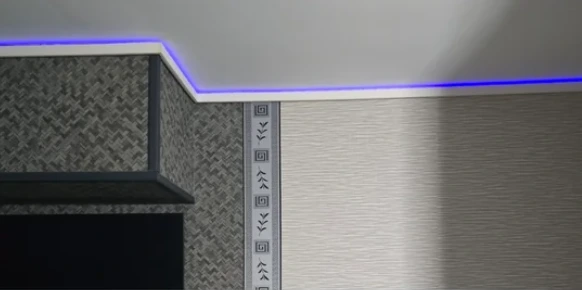
Smart Lighting
- RGB+CCT control
- 5-channel PWM
- Scenes & dimming
Controlled via Home Assistant
EXPLORE THE ECOSYSTEM
Controllers, RS-485 modules, documentation, and ready-to-use ESPHome configurations — all open source.
Product:
Development:
Community:
WHAT MAKES THIS DIFFERENT
Feature | Typical Smart Home | HomeMaster |
| Wi-Fi | RS-485 (wired) |
| Cloud / server | Distributed |
| Stops working | Local logic continues |
| Best effort | Scheduled polling |
| One device at a time | Modules on one pair |
 Communication
 Logic location
 Failure behavior
 Determinism
 Scalability